10 Ways to Use a Notary Before the End of the Year

By Notary and Beyond Services, LLC- Lawrenceville, Ga

As the year winds down, many people focus on holiday plans, family gatherings, and getting ready for the new year. But the end of the year is also one of the most important times to make sure your paperwork is in order – especially documents that protect your family, finances, and future.

A notary plays a major role in helping you finalize, verify, and legally complete documents you may have been putting off all year.

Here are 10 smart ways to use a notary before December 31st.

  1. Finalize Your Power of Attorney Before Holiday Travel

If you’re traveling for the holidays, a Power of Attorney (POA) ensures someone you trust can handle your affairs if something unexpected happens.

You can notarize:

Financial POA

Healthcare POA

Durable POA

Limited POA

This protects you and your family should any emergencies arise.


2. Complete Your Advance Healthcare Directive

An Advance Directive outlines your wishes for medical care if you can’t speak for yourself.
Notarizing it ensures it’s legally recognized by hospitals and healthcare providers.


3. Sign a Minor Child Travel Consent Form

Holiday travel is busy — especially for parents.
If a child is traveling with:

  • Only one parent,
  • A relative,
  • A coach, or
  • A family friend,

…you’ll need a notarized Parent/Guardian Consent for Minor Travel for airlines, borders, and customs.


4. Handle DS-3053 Forms for Passports

A DS-3053 is required when one parent cannot be present during a minor’s passport appointment.
This form must be notarized for acceptance.

Perfect to handle now before passport offices get busy in January.


5. Update or Complete Your Will

Whether you’re revising your will or creating a new one, several pages require notarization to be valid.
This helps protect your assets and ensures your family is cared for exactly as you intend.


6. Real Estate Transactions & Deed Transfers

The end of the year is a major time for:

  • Sale closings
  • Property gifting
  • Adding or removing someone from a deed
  • Refinancing paperwork

Many real estate documents require a notary to finalize the transaction.


7. Small Business Agreements and End-of-Year Financial Documents

Business owners often wrap up financial and legal loose ends in December.
A notary can help you complete:

  • Vendor agreements
  • Lease renewals
  • End-of-year contracts
  • Amendments to your operating agreement
  • Statements of authority

This helps keep your business compliant and ready for January 1.


8. Affidavits for Legal Matters

End-of-year is a busy time for:

  • Name change affidavits
  • Residency affidavits
  • Identity affidavits
  • Lost document statements
  • Insurance affidavits

If it needs to be sworn to or affirmed, a notary can help.


9. Fingerprinting & Background Checks

As a bonus service through Notary & Beyond Services, you can complete your:

  • Employment fingerprint cards
  • Licensing fingerprint cards
  • Background check cards

This is especially helpful if you’re changing jobs or completing certifications before the new year.


10. Prepare for International Document Apostilles

If you have documents going overseas, they may require an apostille.
A notary notarizes the document before the apostille process begins.
Perfect for:

  • Marriage certificates
  • School transcripts
  • Power of Attorney for foreign use
  • Birth certificates (certified)
  • Business documents

Starting this process now saves time and delays in January.


Bonus: Officiant Tip for the Week

Choosing the Perfect Time of Day for an Elopement Ceremony

If you’re planning a winter elopement, consider the lighting and temperature:

  • Morning ceremonies offer soft natural lighting and privacy.
  • Golden hour ceremonies (around 4–5pm in winter) are ideal for romantic photos.
  • Evening ceremonies create a cozy, intimate atmosphere — perfect for candlelit vows.

As an officiant, I guide couples through selecting a time that matches their vibe, photography goals, and comfort level.


Need Notarial or Wedding Services Before the New Year?

Notary & Beyond Services is here to help with all your:
✔ Notary needs
✔ Fingerprinting
✔ Courier/document delivery
✔ Apostille facilitation
✔ Wedding officiant & elopement services

📞 770-899-5531
📧 angelique@notaryandbeyondservices.com
Serving Gwinnett County and surrounding areas.
From Notary Public to Permit Runner: My Exciting New Journey (And How You Can Do It Too!)

Hey fellow go-getters!!

I’m so excited to share something NEW I’m adding to my notary business that can really open doors (literally AND Financially): Permit Running! If you’re like me -someone who loves paperwork, organization, and a bit of a hustle- this is a natural add-on to your notary services. It’s low overhead, high-demand, and best of all…it PAYS well!!

Whether you’re a notary veteran or just getting started, permit running can become a lucrative part of your mobile business. I’m going to walk you through exactly what I did to get started and how you can do it too.

What Is a Permit Runner?

A Permit Runner is someone who physically submits and picks up permit applications (and related paperwork) at local municipalities, city halls, and county offices on behalf of contractors, builders, or homeowners. This helps them save time – and time is money in the construction world!

Why It’s a Perfect Match for Notaries

As notaries, we’re already:

  • Organized
  • Detail-Oriented
  • Familiar with official forms
  • Mobile and professional
  • Trusted with sensitive documents

That’s why permit running a no-brainer. Plus, we’re already used to driving around – why not make extra money doing something similar?

Step-by-Step: How to Get Started as a Permit Runner

  1. Research Local Jurisdictions

First, make a list of:

  • Local City Halls
  • County Offices
  • Building Departments

I would then look at their websites and call them to ask:

  • What permits they accept
  • What their hours are…
  • Whether they allow third-party runners (spoiler: most do)

Tip: Start with your city and the next two surrounding counties. That’ll give you a solid coverage area.

2. Understand the Types of Permits

Most common permits include:

  • Building permits
  • Electrical permits
  • Plumbing permits
  • HVAC/mechanical permits
  • Roofing permits
  • Sign permits

Some offices let you file online, but many STILL require in-person submission or pickups.

3. Create a Permit Running Kit

Here’s what I recommend for you to carry in your permit runner bag:

  • Clipboards
  • Black Pens
  • Copies of common permits forms (you can download from city websites)
  • Notary Stamp
  • Photo ID (some places ask for ID for verification)
  • Business cards

4. Start With The Forms

If your client doesn’t have time to fill them out, offer to do it for them!

Here’s what you do:

  • Ask them for basic project information (address, scope, contractor information, etc)
  • Look up the correct permit form for that jurisdiction
  • Fill in all the basics and leave the signature areas blank
  • Send it back for their approval and signature
  • Pring and submit it

Some Jurisdictions require contractor license info, job cost, and construction type-ask your client to send you that in advance.

5. Pick-up Process: What to Expect

  • Go to the building department of permit office
  • Sign in or give your client’s information
  • Present any required ID or authorization (some cities want a signed authorization letter!)
  • Pay the permit fee (your client will often prepay or reimburse you)
  • Get a copy of the permit and receipt
  • Deliver it to the client or scan/email it

Keep everything organized. A permit log helps track dates, locations, and documents.

Who Should Be Your Clients?

You want to work with busy professionals who don’t have time to stand in line or drive to city hall.

Ideal Clients:

  • General Contractors
  • Electricians
  • Plumbers
  • HVAC techs
  • Roofing companies
  • Architects
  • Interior Designers
  • Small Construction Firms
  • Sign Installers

Bonus: Many of them pull permits multiple times a week or month!

How to Market Permit Running Services

  1. Add Permit Running to Your Website and Google Listing

Update your Google Business Profile, Website, and Social Media bios to include”

“Now offering professional Permit Running services for busy contractors and construction pro!”

2. Email Local Contractors

Create a simple email or flyer with:

  • What you do
  • Areas you serve
  • Your rates
  • Contact Information

Send it to licensed contractors in your area (you can find them on state licensing websites)

3. Visit Supply Houses and Trade Centers

Drop off business cards or flyers at:

  • Plumbing supply stores
  • Electrical supply stores
  • Permit offices bulletin boards
  • Hardware stores

You never know who’s looking for help!

4. Network on LinkedIn and Facebook

Join local contractor or real estate investor groups. Introduce yourself and say:

“If anyone needs help with building permits, I’m a local notary/public permit runner – happy to take the paperwork off your plate!’

5. Offer a First – Time Discount

Get your foot in the door with:

“First permit run $20 off for new clients!’

Sample Pricing

Your pricing should reflect:

  • Travel Distance
  • Wait Time
  • Document Prep

Example:

  • $45 flat fee within 10 miles + .71 cents per extra mile
  • $25 form prep (optional)
  • Additional $25 for expedited/same-day service

Final Thoughts

Permit running can be such a rewarding way to expand your notary business. It allows you to help hard-working professionals, stay organized, and make great income between notary appointments.

If you’re ready to take you notary business to the next level, give permit running a try. You already got the skills – it’s time to put them to work in a brand-new way!

Have questions about getting started? I would love to help. Drop a comment or shoot me a message ( angelique@notaryandbeyondservices.com) Let’s grow together!

    Diversifying Your Notary Stamp: Expanding into Estate Planning, Wills, and Testaments

    Introduction

    As a notary, your stamp is more than just a tool—it’s an opportunity to build a thriving business and serve your community in meaningful ways. One of the most valuable areas to expand into is estate planning, which includes notarizing wills, trusts, and power of attorney documents. Many individuals and families require these services, and by becoming well-versed in this niche, you can provide essential assistance while growing your income.

    This blog will guide you through the steps to research estate planning, gain the necessary knowledge, determine your pricing, build a strong network, and attract clients. Whether you’re just starting out or looking to diversify your services, this guide will equip you with the tools to succeed.

    Researching the Estate Planning Niche

    Before diving into estate planning services, thorough research is essential. Here’s how you can start:

    • Understand Your State’s Laws: Each state has specific regulations regarding notaries’ roles in estate planning. Visit your Secretary of State’s website or consult your state’s notary association.
    • Study Estate Planning Basics: Learn the essential components of wills, trusts, power of attorney, and other related documents. Online legal resources such as Nolo and FindLaw are great starting points.
    • Take Courses & Certifications: Some organizations offer specialized training for notaries in estate planning. Consider courses from the National Notary Association (NNA) or American Society of Notaries.

    Gaining Knowledge to Educate Clients

    While notaries cannot provide legal advice, being fluent in estate planning terminology and processes helps you confidently guide clients through notarization. Resources that can enhance your expertise include:

    • Books on Estate Planning: “Estate Planning Basics” by Denis Clifford is an excellent beginner-friendly book.
    • Webinars & Seminars: Many bar associations and legal organizations offer free or affordable training sessions.
    • Joining Professional Associations: Groups like the National Association of Estate Planners & Councils provide networking and educational resources.

    Pricing Your Estate Planning Notary Services

    Setting competitive yet profitable pricing is crucial. Consider these factors:

    • State Fee Limits: Some states regulate notary fees, so ensure compliance.
    • Travel Fees: If you offer mobile notary services, calculate mileage and time expenses.
    • Package Pricing: Offer bundled services (e.g., will notarization + power of attorney) for a discounted rate.
    • Market Comparison: Research competitors’ pricing in your area to remain competitive.

    Networking to Grow Your Client Base

    Effective networking can lead to long-term partnerships and consistent referrals. Here’s how to build connections:

    • Connect with Estate Attorneys: Lawyers specializing in estate planning often need notary services. Attend local bar association meetings or networking events to introduce yourself.
    • Partner with Financial Advisors: Many financial planners assist clients with estate planning and can refer clients to you.
    • Engage with Senior Communities: Retirement homes and senior centers often require estate planning services. Offer free informational sessions to establish trust.
    • Leverage Online Directories: List your services on platforms like Notary Rotary or 123Notary.

    Generating Clients for Estate Planning Notary Services

    Marketing is key to attracting and retaining clients. Implement these strategies:

    • Optimize Your Website & SEO: Ensure your website includes estate planning notary services with relevant keywords to rank higher in search results.
    • Leverage Social Media: Share informative posts about estate planning on LinkedIn, Facebook, and Instagram.
    • Run Local Ads: Google Ads and Facebook Ads targeting estate planning keywords can attract potential clients.
    • Offer Referral Incentives: Encourage attorneys and clients to refer others by offering discounts or small incentives.

    Conclusion

    Expanding into estate planning notarization can be a lucrative and fulfilling addition to your business. By conducting thorough research, gaining relevant knowledge, setting competitive prices, networking effectively, and utilizing strategic marketing, you can establish yourself as a go-to notary in this specialized field. Start today by exploring the provided resources and taking actionable steps toward business growth!

    Why Notaries Should Expand Beyond Notarizations & Revenue Streams to Consider

    Hey everyone! I know it’s been a little while since my last post, and I truly appreciate your patience. Between getting Purely Wed by Sabrina off the ground and keeping Notary and Beyond Services running strong, life has been incredibly busy. But I’m back, and I’m excited to share more valuable insights to help notaries and entrepreneurs grow their businesses!

    Today, I want to talk about an important topic-why notaries should expand beyond traditional notarizations and explore additional revenue streams. Whether you’re looking to stabilize your income, attract more clients, or simply grow your business, diversification is key. Let’s dive in!

    The notary business can be both rewarding and lucrative, but it also has its limitations. Many notaries rely solely on traditional notarization services, which can be unpredictable due to market fluctuations, legal changes, and seasonal slowdowns. To build a stable and thriving business, notaries should consider diversifying their income streams by offering complementary services. Expanding beyond notarizations not only increases revenue potential but also enhances your value to clients, making you a one-stop resource for essential services.

    In this blog, we’ll explore why notaries should expand their offerings and highlight one of the most profitable and fulfilling revenue streams–wedding officiant services.

    Why Expand Beyond Notarizations?

    1. Overcome Income Fluctuations.

      Notary work is often unpredictable. Some months may be incredibly busy, while others are slow. By adding new services, you create multiple sources of income, reducing the financial uncertainty that comes with an inconsistent workflow.

      2. Maximize Your Existing Skills & Credentials

      As a notary, you already have valuable skills that can easily translate into additional services. Many stats allow notaries to officiate weddings, handle estate planning documents, or offer fingerprinting services. Expanding your offerings doesn’t always require extensive new training – it’s about leveraging what you already know.

      3. Attract More Clients & Increase Repeat Business

      Offering multiple services increases your visibility in the market. For example, a couple who hired you to officiate their wedding may later need a notarized marriage license, estate planning documents, or a power of attorney. By offering diverse services, you encourage repeat business and referrals.

      4. Set Yourself Apart from Competitors

      The notary field is competitive, and those who offer only standard notarization services may struggle to stand out. Expanding your service list makes you more appealing to potential clients and gives you an edge over competitors who limit their offerings.

      Revenue Streams to Consider: Wedding Officiant Services

      One of the most lucrative and enjoyable services a notary can offer is wedding officiating. In many states, notaries have the legal authority to perform wedding ceremonies, making this an excellent opportunity for business expansion.

      Why Offer Wedding Officiant Services?

      • High Demand – Weddings take place year-round, and many couples are seeking affordable and professional officiants for elopements and intimate ceremonies.
      • Good Profit Margins – A single wedding ceremony can bring in between $150 to $500, depending on location, customization, and travel.
      • Emotional & Rewarding Work – Officiating weddings allows you to be part of one of the most important days in a couple’s life, making it a fulfilling service.
      • Cross – Selling Opportunities – Couples who need an Officiant often need additional services, such as, notarization for marriages licenses, name change documents, and estate planning.

      How to Get Started as a Wedding Officiant

      1. Check your State Laws-Verify that your State allows notaries to officiate weddings and ensure you meet any licensing or registration requirements.
      2. Develop Your Services Offerings-Decide on your pricing, package options (basic ceremony, customized vows, pre-marital counseling), and aly add-ons you’d like to offer.
      3. Market Your Services – Promote your wedding officiant services through:
      • A website with a dedicated page for wedding officiating.
      • Social Media platforms ( NextDoor, Instagram, Pintrest, TikTok or Facebook)to showcase past ceremonies, testimonials, and tips for couples.
      • Wedding directories such as The Knot or WeddingWire
      • Networking with wedding planners, photographers, and venues.

      4. Create a Professional Brand – Choose a business name and tagline that reflect your style. If you already have a notary business, consider creating a separate brand identity for weddings to appeal to a different audience.

      Other Revenue Streams to Consider

      • Estate Planning Services – Assist clients with notarizing wills, power of attorney, and other legal documents. Partnering with estate attorneys can bring consistent referrals.
      • Fingerprinting Services – Many businesses and agencies require fingerprinting for background checks. This service is in demand and can be a profitable addition.
      • Apostille & Document – Authentication Services- Help clients with the legalization of documents for international use. The niche service can command high fees.
      • Loan Signing Agent Services – Specializing in real estate closings as a notary signing agent can be a lucrative revenue stream.
      • Document Courier Services – Deliver important legal and financial documents for attorneys, businesses, and individuals.

      Final Thoughts

      Expanding beyond notarizations is a smart move for any notary looking to build a sustainable, profitable business. Whether you choose to offer wedding officiant services, estate planning, fingerprinting. or other complimentary services, diversification can help you reach new clients and increase your income.

      If you’re a notary ready to take your business to the next level, start exploring new opportunities today!

      Interested in learning more about business expansion? Subscribe to my blog, Beyond the Notary Seal, for expert insights, tips, and real-world strategies. And don’t worry, a Podcast is coming soon.

      “The Do’s and Don’ts of Notarizing Immigration Documents: Understanding a Notary’s Role”

      The role of notaries in the U.S. is strictly limited when it comes to immigration matters, as immigration law is highly regulated and outside the scope of a notary’s authority. Here’s an overview of what notaries can and cannot do in these situations:

      What Notaries Can Do:

      1. Authenticate Signatures on Immigration Documents: Notaries can notarize the signatures on immigration-related forms, such as affidavits or applications, as long as the notarial act complies with state laws. For example, a notary may administer oaths or affirmations for affidavits of support or verify identity for signed applications.
      2. Provide General Notarial Services: Notaries can perform notarial acts unrelated to immigration law, such as acknowledgments or jurats, as long as the individual provides the proper documents and identification.
      3. Refer to Qualified Legal Professionals: Notaries can refer individuals to immigration attorneys or accredited representatives who are authorized to provide legal advice.
      4. Act as a Translator or Prepare Certified Translation: If allowed by stated law and they are qualified, notaries may assist with translation documents. However, this should be done separately from their role as a notary.

      What Notaries Cannot Do:

      1. Provide Legal Advice: Notaries Cannot advise individuals on immigration matters, including how to obtain legal status or complete immigration forms, unless they are also licensed attorneys or accredited by the Department of Justice.
      2. Assist with Completing Immigration Forms: Unless specifically authorized, notaries cannot help immigrants fill out forms like the N-400 for naturalization of I-485 for a green card.
      3. Impersonate Immigration Authorities: In some countries, the title “notario publico” implies legal expertise, but in the U.S., notaries cannot use this title to imply they have legal authority over immigration matters.
      4. Guarantee Results: Notaries cannot promise or guarantee outcomes, such as ensuring someone’s citizenship or legal status.

      Potential Conflict of Importance of Notaries:

      • Conflict: If a notary provides unauthorized legal advice or oversteps their role, they could face severe legal penalties, including fines, revocation of their commission, and even criminal charges. This is especially problematic in immigrant communities where individuals may mistakenly view notaries as legal advisors.
      • Importance: Notaries serve as vital impartial witnesses in the immigration process. By adhering to their legal duties, notaries can help prevent fraud, protect vulnerable individuals from exploitation, and ensure the authenticity of signed documents used in immigration applications.

      Remaining knowledgeable about state and federal laws surrounding notarial duties and immigration is critical to staying within your professional boundaries. If immigration-related services are of interest, seeking DOJ accreditation may allow you to expand your services legally and ethically.

      By understanding the limits of their authority and adhering to legal and ethical standards, notaries can provide invaluable support to clients while safeguarding their professional integrity.

      “How Trump’s Recent Executive Order Impacts Notaries: Navigating Challenges and Opportunities.”

      Donald Trump’s recent executive orders have introduced significant changes to the U.S. immigration policies, which may indirectly affect the work of notaries. Here’s how these developments could impact your role:

      1. Increased Demand for Notarial Services:
      • The new executive orders aim to overhaul U.S. immigration law and policy, affecting various aspects of the immigration system. These changes may lead to a surge in individuals seeking to adjust their legal status or challenge deportation orders, resulting in a higher demand for notarized documents such as affidavits, powers of attorney, and other legal forms. (American Immigration Council)

      2. Heightened Risk of Unauthorized Practice of Law:

      • With the evolving immigration landscape, individuals may turn to notaries for assistance beyond the scope of notarization, such as legal advice or help with completing immigration forms. It’s crucial to remain vigilant and clearly communicate the limitations of your role to avoid engaging in unauthorized Practice of Law. Providing legal advice without proper authorization can lead to legal consequences and damage your professional reputation. (National Immigrant Justice Center)

      3. Navigating Legal and Ethical Challenges:

      • The executive orders have faced legal challenges, with some being clocked by federal judges for being deemed unconstitutional. This ongoing legal uncertainty can create confusion for both notaries and clients regarding the validity of certain documents or procedures. Staying informed about the current legal status of these orders is essential to ensure compliance and provide accurate information to clients. (cnn.com)

      Best practices for Notaries:

      • Stay informed: Regularly update yourself on changes in immigration laws and policies to understand the context in which your notarial services are requested.
      • Maintain Professional Boundaries: Clearly communicate the limits of your role to clients and avoid offerings legal advice or assistance in completing immigration forms.
      • Refer to Qualified Professionals: If clients require legal assistance, refer them to licensed immigration attorneys or accredited representatives authorized to provide such services.

      By adhering to these practices, you can navigate the evolving landscape of immigration policy while fulfilling your duties ethically and legally.

      How to Price Your Notary Services: A Comprehensive Guide for Success

      Setting the right price for your notary services is crucial for running a successful and sustainable business. As a notary, your pricing structure should not only reflect the value of your time and expertise but also comply with state regulations. From administrative fees to travel expenses and per-stamp charges, understanding how to calculate and communicate your fees ensures transparency and professionalism. In this guide, we’ll walk you through the key components of notary pricing and provide practical tips to help you create a fair and competitive rate. Please check with your state regulations regarding what and how much you are allowed to charge.

      Pricing for general notary services should consider the following factors:

      1. Administration Fee: Charge a flat fee for tasks such as scheduling, record-keeping, and client communication. For instance, a reasonable administration fee could be $10-$25, depending on the complexity of your process.
      2. Per-Stamp Fee: Each state regulates how much a notary can charge per notarized signature or stamp. Research the maximum allowable fee for your state. For example:
        • California: $15 per notarized signature
        • Texas: $6 per notarized signature
        • Florida $10 per notarized signature
        • Georgia $2 per notarized signature
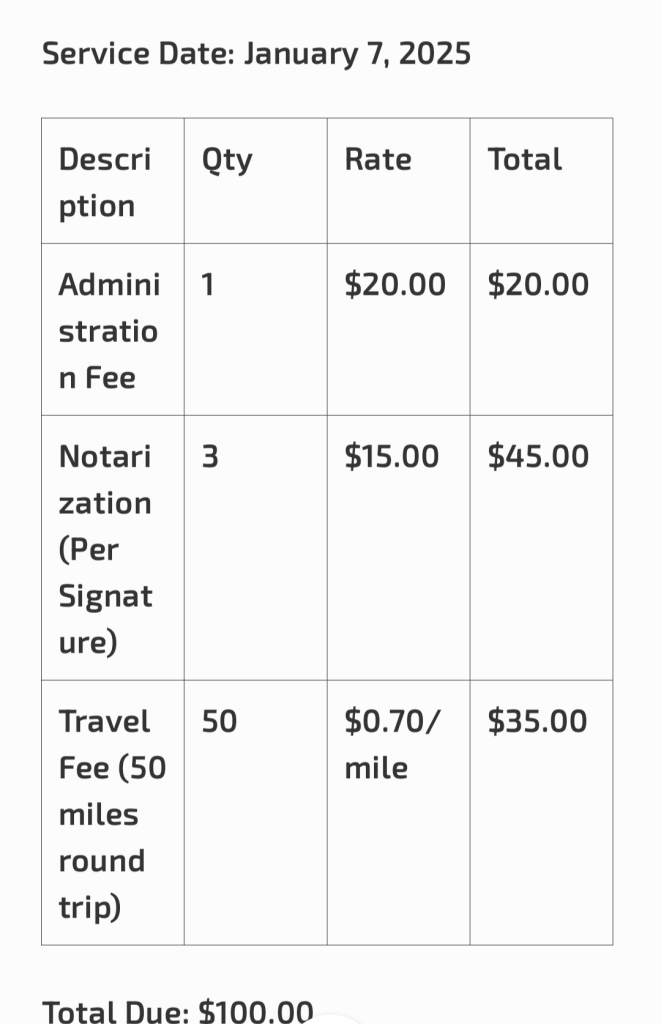
      3. Travel Fees: In most states, you can charge a travel fee in addition to your per-stamp fee. Be sure this is agreed upon before the appointment. For example, the travel fee is .70 per mile. (Per IRS.Gov this increase began Jan 1, 2025)

      Here’s a sample breakdown for a general notary service in a state like California:

      This format ensure clarity and professionalism while detailing the costs for your clients’. Adjust rates according to your state laws and specific business policies. And it would not hurt to use Canva to create a more professional and branded invoice form to provide for your clients.

      The Ultimate Guide to Essential Equipment and Branding for Your Notary Business

      Starting and running a notary business requires more than just the knowledge and certification. The right tools and branding strategies can set you apart from the completion and streamline your operations. Here’s a guide to the essential equipment and tips for creating a professional, memorable brand.

      Equipment You Need for a Notary Business :

      A Reliable Printer and Scanner

      A multi-function printer and scanner are essential for any notary. Look for models that provide fast, high-quality printing and scanning capabilities.

      Recommended Features

      • Dual trays (to handle both letter and legal-sized paper).
      • Wireless connectivity for convenience.
      • High-speed scanning to meet client deadlines.

      Top Picks:

      • Brother DCP-L2640DW: A dependable, all-in-one monochrome laser printer. It only has one tray but you can always start here due to expenses. And then later up-grade to HL-L5210DWT Monochrome Laser Printer with Dual Tray. It’s always good to have a back up printer as your business grows.

      Stamps and Seals

      Invest in high-quality stamps and Seals that meet your state’s requirements. Choose customizable options to include your name and commission information for a polished look.

      Where to Order:

      • Notary-specific suppliers like the National Notary Association or Notary Rotary.
      • Online platforms like Amazon or Office Depot for customizable options.

      Mobile Equipment for Traveling Notaries

      If you’re a mobile notary you’ll need:

      • A portable scanner (e.g., Fujitsu ScanSnap iX100 or Canon imageFORMULA R10)
      • A lightweight laptop or tablet for managing documents on the go.
      • A secure bag or case to store your supplies.

      Business Cards and Marketing Materials

      Business cards are essential for networking and promoting your services. They should include:

      • Your name and title
      • Contact information
      • A list of core services
        • Where to order
          • Vistaprint: Affordable and customizable templates.
          • Moo: Premium designs for a professional look.
          • Canva: Design and order cards on one platform.

      Notary Journal

      A detailed notary Journal is required in many states to track each notarization you perform. Choose a durable well-organized journal with plenty of space for notes.

      Create a business account with FedEx and UPS.

      • It’s helpful to have access to resources for ordering supplies like poly bags and shipping envelopes.

      Branding Your Notary Business

      1. Choose a Memorable Name
        • Your Business name is the foundation of your brand. It should reflect your professionalism and services. Examples:
          • Purely Professional Notary Services
          • Elite Mobile Notary Solutions
          • Notary and Beyond Services (This name is already taken, lol)
      2. Create a Logo
        • A unique logo builds recognition and credibility. Use platforms like Canva, hire a designer on Fiverr, Facebook actually have individuals who will charge a reasonable price, or 99designs to create one that aligns with your business name and values.
      3. Build an Online Presence
        • A professional website and social media profiles are critical for reaching potential clients.
          • LinkedIn*
          • Facebook
          • Instagram
          • TicTok
        • Include essential information like your services, contact details, and pricing.
        • Use platforms like Squarespace, Tailor Brands, or Wix for website building.
      4. Invest in Marketing
        • List your services on Google My Business for local SEO benefits.
        • Utilize targeted ads on platforms like Facebook or Instagram.
        • Offer referral discounts to encourage word-of-mouth marketing.
      5. Professional Appearance
        • Your branding extends to how you present yourself.
          • Dress professionally for appointments
          • Use branded folders to present documents..
          • Get an ID badge. You can get one customized for you through Zazzle. `

      Final Thoughts

      Running a notary business requires organization, professionalism, and the right tools. By investing in reliable equipment and building a strong consistent brand, you’ll not only attract clients but also create a lasting impression that sets you apart.

      Are you ready to take your notary business to the next level? Start with these essentials, and watch your business grow!

      Stop Comparing and Start Building: Making Your Notary Business Uniquely Yours

      In the notary world, it’s easy to get caught up in comparison. Social media posts showcasing others’ success, stories of six-figure notaries, or hearing about a competitor’s big break can leave you wondering, Am I doing enough? Am I successful? But here’s the truth: your notary business doesn’t have to look like anyone else’s. In fact, it shouldn’t.

      Your success is not defined by someone else’s achievements. Instead, it’s about creating a brand and business that’s uniquely yours – a reflection of your values, strengths. and goals. Here’s how to let go of comparison and focus on building a notary business that’s truly you.

      Embrace Your Own Journey

        No two notary businesses are the same, and that’s the beauty of this industry. While some notaries may specialize in loan signings or target corporate clients, others might focus on niche services like wedding officiating, fingerprinting, or estate planning.

        Think about your skills, passions, and community. Are you particularly good at connecting with people? Maybe your strength lies in offering mobile services to busy families. Your journey isn’t about mirroring someone else’s – it’s about finding where you shine.

        Define Your Brand

        Your brand is more than just a logo or business card; it’s the message and image you share with the world. Ask yourself:

        • What do I want my business to represent?
        • What problems do I solve for my clients?
        • What kind of experience do I want to deliver?

        For Instance, if you pride yourself on professionalism and reliability, your branding should reflect that in every touch-point from your website to how you answer the phone. If you’re all about convenience, emphasize your mobile services and flexible scheduling.

        Your unique personality and approach can set you apart. Some notaries make their business approachable and friendly, while others cater to high-end clients with luxury-level services. Make sure your branding aligns with the type of clients you want to attract.

        Learn, Adapt, and Innovate

        It’s perfectly fine to look at what others are doing – not to compare, but to gather ideas. Use their success as inspiration, not as a yardstick for your worth.

        • Follow other notaries for tips, but adapt them to fit your style.
        • Attend webinars, workshops, or local networking events to stay updated and gain new insights.
        • Take what resonates with you and leave the rest.

        For example, if you notice a trend in online notarization but you’re more comfortable with face-to-face interactions, consider offering hybrid options. (Check your state laws and regulations, all states are different) Use industry knowledge to build services that feel authentic to you and meet your clients’ needs.

        Focus on Relationships, Not Competition

        Clients hire notaries they trust. Building relationships with your community and networking with other professionals will take you further than worrying about what your competitors are doing.

        • Partner with real estate agents, attorneys, and local business.
        • Use social media to connect with people in your area.
        • Always prioritize exceptional service – referrals and repeat clients will follow.

        By focusing on building relationships, you’ll carve out your niche and build a client base that values your unique approach.

        Celebrate Small Wins

        It’s easy to discount the little victories when you’re busy comparing yourself to someone else’s highlight reel. Celebrate your progress, no matter how small it seems.

        • Your first five-star review? That’s huge!!
        • Adding a new service to your offerings? That’s growth!!
        • Completing a difficult signing or helping a nervous client feel at ease? That’s a success!!

        By focusing on your own progress, you’ll feel more confident and motivated to keep going.

        Stay Authentic

        Your notary business doesn’t need to look like anyone else’s because your story, skills, and personality are one of a kind. Authenticity is what attracts clients. Let them see the real you – whether it’s your sense of humor, your compassion, or your meticulous attention to detail.

        When you stop comparing and start focusing on what makes you unique, you’ll naturally stand out in the marketplace.

        Final Thoughts

        The notary business is big enough for everyone. Instead of stressing about how successful someone else is, channel that energy into creating a business you’re proud of – one that reflects your values and serves your clients’ in a way only you can.

        Take inspiration, but don’t imitate. Learn, grow, and build a business that feels authentic and sustainable. Success isn’t a race; it’s a journey – and your journey is worth celebrating every step of the way.

        Stamped for Success: You’re a Commissioned Notary Public! What’s Next?

        Congratulations on receiving your notary commission! Here are the key steps to take next to establish yourself as a notary public and set up your business effectively:

        1) Understand Your State’s Notary Laws

        • Review your state’s notary handbook to ensure you are familiar with the rules and guidelines.
        • Note requirements for record keeping, fees you can charge, and any limitations on your authority.

        2) Obtain Your Notary Supplies

        • Purchase a notary seal or stamp that meets your state’s requirements.
        • Acquire a Notary Journal for record keeping, even if it is not required in your state-it is good practice.
        • If needed, invest in an embosser or additional supplies like acknowledgement and jurats certificates. This really comes in handy for your general notary clients.

        3) Get Bonded and Insured

        • If your state requires a notary bond secure one before starting any official business.
        • Consider purchasing errors and omissions (E&O) insurance for personal liability protection. You can look into the National Notary Association (NNA) or Notary Rotary, just to name a few.

        4) File Your Commission

        • If you have not done so already, ensure that you file your commission with the county clerk’s office before performing notarial acts. Just be sure to check your state requirements.

        5) Set Up Your Notary Business

        • Register your business with your Secretary of State. Choose a business name, register with your local authorities, and obtain any necessary permits or licenses. Most people set up a home based business when they start becoming a business owner and do not need those things to run their business. Please check to see what your state law requires to ensure that you are in compliance.
        • Get an EIN: Obtain an Employer Identification Number (EIN) from the IRS.GOV site. This is good to have if you are looking to expand with employees in the future.
        • Open a business bank account to keep your finances separate from your personal accounts.

          6) Market Your Services

          • This is the time you will do some serious thinking of what you would like to have as your niche.
          • Create a website to showcase your services, including specialized offers like wedding officiant, estate planning support or fingerprinting. A lot of notary newbies start out as a loan signing agent to get their feet wet and become familiar with important legal documents.
          • Use Google Business Profile to make your business discover-able locally.
          • Network with real estate professionals, law firms, and local businesses that often require notary services.

          7) Please, Invest in Training and Certifications

          • Take additional courses or obtain certifications if you plan to offer specialized services like loan signings or apostille facilitation.
          • Join professional organizations like the National Notary Association (NNA), The Notary Coach, or The Notary Academy for resources and ongoing education.

          8) Set Up Your Tools and Technology

          • Consider getting mobile notary software for scheduling and invoicing. I personally use the app Notary Assistant and Square. There are others out there to look into once you do a little research.
          • Invest in a reliable printer and scanner, especially for clients requiring copies or legal size of notarized documents.

          9) Your Rates

          • As previously mentioned, find your niche. Once you have determined what that will be, decide on what your rates and policies for travel fees, cancellations, and additional services will be.
          • Decide on rates for specialized or extra services
            • a) After hours or rush jobs: Charge a premium for services outside of regular hours or urgent requests
            • Printing/Copying: Add fees for printing documents
            • Waiting Time: Include an hourly or per-minute fee if you’re kept waiting beyond a reasonable period.
            • Apostille Services: Set separate rates if you’re handling document authentication. ( I will go a little deeper in this topic in another posting)

          10) Start Building Your Client Base

          • Attend local networking events and join community organizations to spread awareness of your services.
          • Offer promotional deals to attract your first clients.
          • Volunteer at your local adult living facilities. There is nothing better than a family who is in desperate need of a notary and discovers that one is within their reach.

          Becoming a notary is an exciting step towards building a flexible and rewarding career. By taking These essential steps, you’ll be well on your way to establishing a successful notary business and providing valuable services to your community. Remember, your commission isn’t just a stamp – it’s an opportunity to make meaningful connections and grow professionally. Whether you’re focused on general notarization, mobile services, or specialized areas like wedding officiating or loan signings, the possibilities are endless. Now, it’s time to get out there and make your mark. literally.

          If you ever need any help or would like a mentor, feel free to contact me.

          Angelique Abercrombie, owner of Notary and Beyond Services, LLC. My email is: angelique@notaryandbeyondservices.com